Well Yield: How Much Water Will Your Well Produce?
Finding water is only half the battle. A well that delivers a trickle when you need a shower, a garden and a washing machine running at once is a failed well – even if it's "wet". This guide explains, in plain language, the physics that sets a well's capacity, and how professionals (and now anyone) estimate it before drilling.
What happens when the pump switches on
Pumping lowers the water level inside the well. That creates a difference in water level – a hydraulic gradient – between the surrounding aquifer and the well, and groundwater begins flowing radially toward it from all directions. The water table around the well takes the shape of a funnel: the cone of depression. The vertical drop of the level in the well is called drawdown, and the distance out to where the effect fades is the radius of influence (Radulović, 2026).
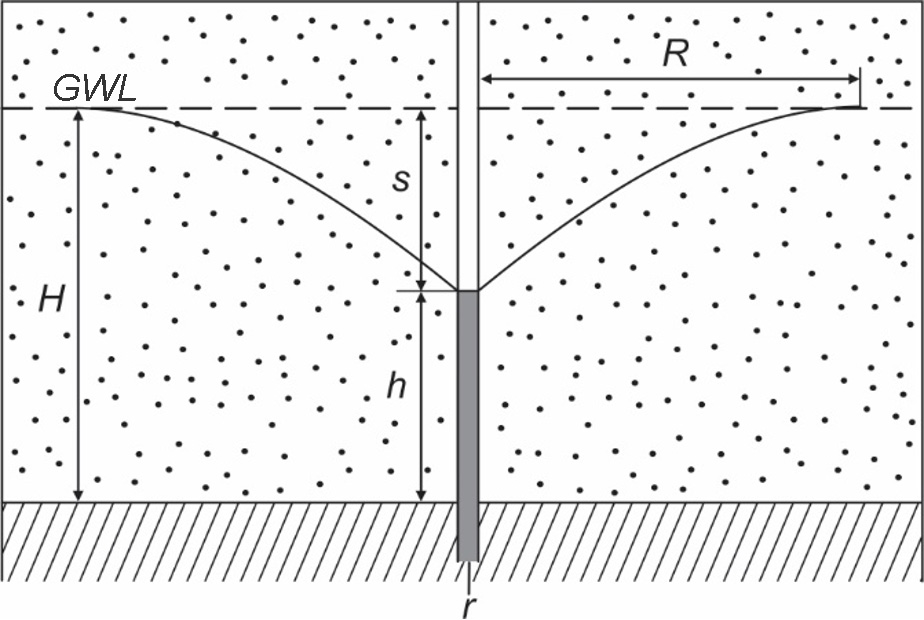
A steady state is reached when inflow from the aquifer equals the pumping rate. Pump harder and the drawdown deepens; pump beyond what the aquifer can deliver and the level keeps falling until the pump breaks suction. Every well therefore has a sustainable ceiling set by the aquifer, not by the pump you install.
The two numbers that set the ceiling
Hydrogeology compresses most of the answer into two parameters (Radulović, 2026):
- Transmissivity (T) – how easily the aquifer conducts water: permeability × saturated thickness. A thick gravel bed has enormous T; a thin fractured sandstone, little.
- Storage – how much water the aquifer releases as the level drops (specific yield in unconfined aquifers). Sands and gravels release much; clays hold their water tight.
Add construction factors – how much of the saturated thickness the well penetrates (a fully penetrating well outperforms a shallow one in the same spot), screen quality, and well diameter – and you have the well's realistic capacity. This is why identical pumps give wildly different results in different geology: the rock decides. See which rocks make good aquifers.
How professionals measure yield: the pumping test
After drilling, the definitive answer comes from a pumping test: the well is pumped at several successively higher rates while drawdown is recorded, ideally during the driest period of the year. Plotting pumping rate (Q) against stabilised drawdown (S) reveals the relationship between the two and hence the optimal yield – the highest rate the well sustains without excessive drawdown (Radulović, 2026). Test data also yield the aquifer parameters themselves, using methods based on the Theis equation of radial flow toward a well. For karst aquifers, long-duration tests show characteristic multi-stage behaviour as different fracture systems drain – one more reason limestone terrain deserves expert interpretation (Radulović, 2026).
How much do you actually need?
| Use | Continuous yield (orientation) |
|---|---|
| Weekend cottage | ~0.05–0.1 L/s |
| Household (family + garden) | ~0.2–0.5 L/s |
| Small farm / irrigation | 0.5–5 L/s |
| Community / commercial supply | 5+ L/s |
Modest yields are usable with storage: a low-yield well pumping into a tank around the clock covers large peak demands. What you cannot fix afterwards is drilling in ground that yields (almost) nothing – which is exactly the risk a pre-drilling estimate helps you reduce.
wheretodigwell.com combines aquifer, geological, terrain and climate data to estimate the expected well yield at any location on Earth. The depth to groundwater is free; unlock a location to see its expected yield and drilling suitability — the detailed AI report, which explains what's driving the numbers at your site, is included (from $9.80).
Check your location →
Frequently asked questions
What is a good yield for a household well?
Around 0.2–0.5 L/s (3–8 gpm) continuous is comfortable; less works with a storage tank.
What determines a well's capacity?
The aquifer's transmissivity and storage, plus how much of the aquifer the well penetrates and the quality of its construction. The rock sets the ceiling; the pump only reaches it.
Why does the level in my well drop while pumping?
That's drawdown – the normal cone of depression forming. It should stabilise; continuously falling levels mean the rate exceeds what the aquifer can supply.
Next: how deep is the water table · the best place on your property · the complete siting guide
References:
Radulović M.M. (2026). Hidraulika podzemnih voda – izvod iz predavanja (Groundwater Hydraulics – Lecture Notes). University of Montenegro, Faculty of Civil Engineering, Podgorica.
Radulović Đ.M. (2003). Osnovi geologije (Fundamentals of Geology). University of Montenegro, Faculty of Civil Engineering, Podgorica, 234 p.
Note: Estimates from wheretodigwell.com are a preliminary, data-based screening tool, not a guarantee of groundwater conditions at any specific site. Actual depth, yield and water quality can only be confirmed by drilling and testing, and local conditions may differ from regional data. Always check local regulations before constructing a well.