Dug Well vs Drilled Well: Which One Do You Need?
The choice between digging and drilling isn't really a matter of preference or even budget – it's dictated by one number: the depth to the water table on your land, together with the kind of ground above and below it. Here's how the options compare and how to decide in minutes.
The three ways to make a well
Hand-dug wells
The classic wide well (0.8–1.5 m diameter), excavated by hand or excavator and lined with concrete rings, brick or stone. Practical only in soft ground (soil, sand, gravel, weathered rock) and only where groundwater is shallow – realistically within ~10 m, exceptionally 20 m. Advantages: low cost, no rig access needed, and the large diameter stores water, which helps in low-yield ground – the well fills overnight and gives you a usable volume each morning. Drawbacks: it taps the uppermost, most pollution-exposed groundwater; it's the first to dry up in drought; and digging below the water table is difficult and hazardous – which is why dug wells often end barely a metre or two into the aquifer.
Driven / jetted wells
A small-diameter pipe with a screened point, hammered or washed into loose sand where the water table is very shallow (typically <8–10 m). Quick and cheap, but low-yield and limited to soft, stone-free sediments.
Drilled wells (boreholes)
A machine-drilled hole, usually 10–30 cm in diameter, lined with casing and fitted with a screen against the water-bearing layer, with a sanitary seal near the surface. A rig drills through any material to almost any depth – 30, 100, 300 m – reaching deeper aquifers that are better protected from contamination and more stable through the seasons, including confined (artesian) aquifers where water rises up the borehole under its own pressure (see aquifer types).
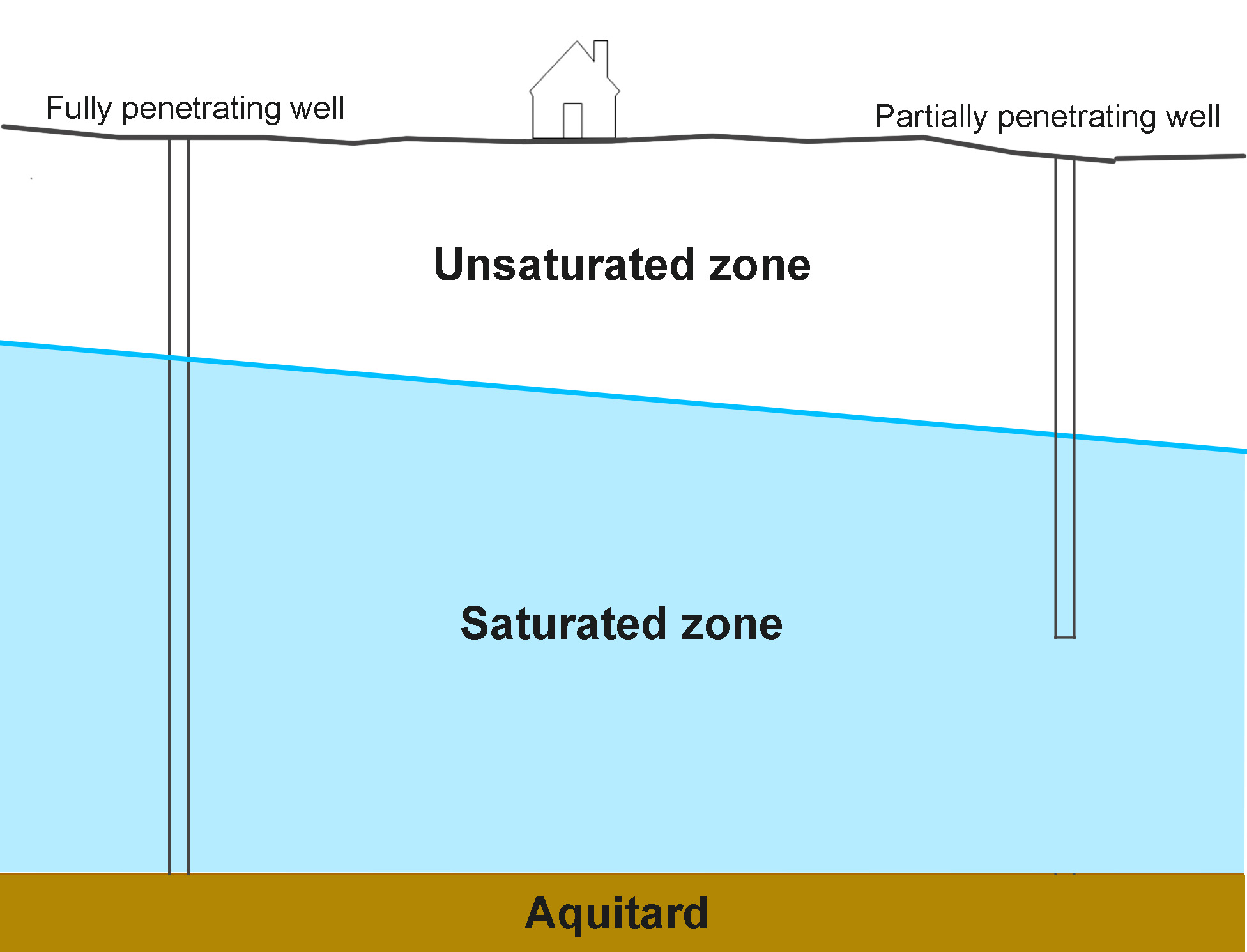
Side by side
| Dug well | Drilled well | |
|---|---|---|
| Works when water table is… | <10 m (soft ground only) | Any depth |
| Ground type | Soil, sand, gravel | Anything, incl. hard rock |
| Contamination risk | Higher (shallow, open structure) | Lower (cased and sealed) |
| Drought resilience | Low – first to dry up | High – taps deeper reserves |
| Storage effect | Large (big diameter) | Small – depends on aquifer yield |
| Typical cost logic | Cheap if water is shallow | Cost scales with depth – the estimate matters |
Why depth must be known before you choose
Every branch of this decision starts with the same two numbers: depth to groundwater and expected yield. Water at 6 m in a sandy valley? A dug or driven well is the rational, economical choice. Water at 40 m under fractured limestone? Only a borehole will do, and you'll want to know the expected yield before committing to per-metre drilling costs. And in all cases the well must go comfortably below the water table – levels fall in the dry season and fall further when the pump runs (Radulović, 2026) – see how drawdown works.
wheretodigwell.com instantly estimates the depth to groundwater for your exact location – free, worldwide. Unlock a location to see its drilling suitability and expected well yield, with the detailed AI report included (from $9.80) – local geology and a recommended well type and depth.
Check your location free →
Frequently asked questions
How deep can a hand-dug well go?
Usually 5–15 m; beyond ~20 m it becomes dangerous and uneconomical. If your water table is deeper than ~10 m, plan on drilling.
Is a drilled well better than a dug well?
It reaches deeper, cleaner, more drought-proof water and works in any ground – but a dug well can be the smarter buy where water is shallow and yields are low, thanks to its built-in storage.
Should the well go deeper than the water table?
Always. Design for the lowest seasonal level plus pumping drawdown, with the pump safely submerged below both.
Next: the best place on your property to drill · the complete siting guide
Reference: Radulović M.M. (2026). Hidraulika podzemnih voda – izvod iz predavanja (Groundwater Hydraulics – Lecture Notes). University of Montenegro, Faculty of Civil Engineering, Podgorica.
Note: Estimates from wheretodigwell.com are a preliminary, data-based screening tool, not a guarantee of groundwater conditions at any specific site. Actual depth, yield and water quality can only be confirmed by drilling and testing, and local conditions may differ from regional data. Always check local regulations before constructing a well.