How to Know Where to Dig a Well for Groundwater
Deciding where to dig or drill a well used to mean guesswork, folklore, or paying for exploratory boreholes and hoping for the best. It doesn't have to. Groundwater follows physical laws that hydrogeologists have understood for over a century, and today the data needed to apply those laws to your land is available in seconds. This guide explains what actually determines where water is found, how professionals choose drilling sites, and how you can get a science-based first estimate of the depth to groundwater for any location on Earth – free.
First, the good news: groundwater is almost everywhere
When rain falls on permeable ground, part of it infiltrates and percolates downward through the unsaturated zone until it reaches the water table – the level below which all pores and fractures in the rock are completely filled with water. This saturated zone is called an aquifer. Groundwater is part of the natural hydrological cycle, constantly recharged by precipitation and slowly flowing toward rivers, lakes, springs, and the sea (Radulović, 2026).
So the question is rarely whether there is water beneath your land. It is:
- How deep is the water table? (This determines cost and whether digging by hand is even possible.)
- How much water can the rocks deliver to a well? (A well in dense clay may be technically "in water" yet yield almost nothing.)
- Where on the property are conditions best?
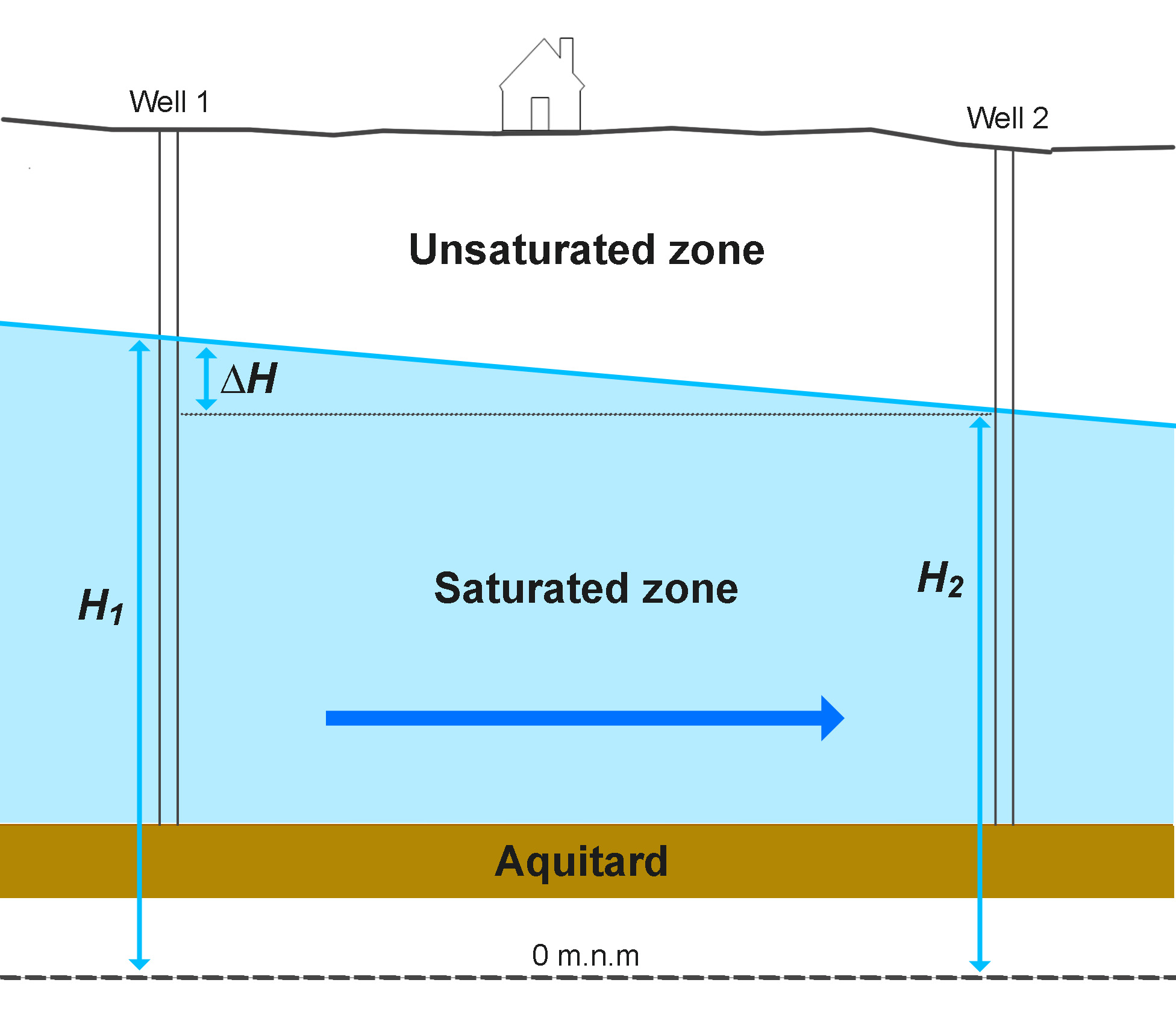
What determines where water is: geology
Two properties of the ground control everything. Porosity – the share of a rock's volume made of open spaces – determines how much water it can store. Permeability determines how easily that water moves toward a well. Loose sands and gravels are excellent on both counts; fractured limestone can carry spectacular amounts of water through cracks and karst channels; solid granite or thick clay yields very little (Radulović, 2026). If you know what lies under your land, you already know most of the answer – our guide to aquifer types and which rocks hold water covers this in detail.
Reading the landscape
Before any instruments, hydrogeologists look at the terrain, because the water table broadly follows a subdued version of the topography:
- Valleys and low ground – the water table is closest to the surface here; rivers exist precisely because groundwater discharges into them.
- The foot of slopes – water infiltrating on higher ground moves downslope and accumulates.
- Springs and seeps – direct proof that the water table intersects the surface nearby; springs typically appear at the contact between permeable and impermeable rocks (Radulović, 2026).
- Vegetation that stays green in drought – willows, poplars, and reeds signal shallow groundwater.
We cover these indicators – and which popular "signs" to ignore – in natural signs of groundwater.
How professionals choose a drilling site
A hydrogeologist working on a water-supply borehole typically combines: geological and hydrogeological maps; records from existing wells and boreholes in the area (depth to water, yield, geological logs); analysis of recharge – how much precipitation infiltrates in the catchment (Radulović, 2026); and, for expensive projects, geophysical surveys such as electrical resistivity, which detect water-bearing layers from the surface. The output is an estimate of depth to the water table, the expected yield, and the recommended drilling depth and location.
This work is worth every cent for a municipal wellfield. For a household well, the traditional version of it can cost more than the drilling itself – which is why most people historically skipped it and drilled blind.
wheretodigwell.com uses global groundwater, geological, terrain and climate datasets to estimate the depth to groundwater for any point you click on the map – anywhere in the world. The depth estimate is free; unlock a location to also see its expected well yield and overall drilling prospects, with a detailed AI report for your exact parcel included – from $9.80.
Check your location free →
A simple decision path
| Step | What to do |
|---|---|
| 1. Screen the location | Get a free estimate of the depth to groundwater for your parcel at wheretodigwell.com, and unlock the location to see its drilling suitability and expected yield. |
| 2. Check the depth | Shallow water table (<10–15 m)? A dug or driven well may suffice. Deeper? You'll need a drilled borehole – see dug vs drilled wells. |
| 3. Check the yield | Compare the expected yield with your needs (a household typically needs a fraction of 1 L/s) – see well yield explained. |
| 4. Pick the exact spot | Respect setbacks from septic systems and pollution sources – see the best place on your property. |
| 5. Verify locally | Talk to neighbours with wells and to local drillers; their depth and yield data are gold. For high-cost boreholes, commission a hydrogeological survey. |
What the results can be used for
Knowing the depth to the water table (and a location's drilling suitability and expected yield) is useful well beyond digging a well:
- Environmental impact assessment (EIA) — baseline depth-to-groundwater information when evaluating a project's effects on the environment and on groundwater resources;
- Civil engineering & mining — anticipating the dewatering (drainage) of excavations, foundations, tunnels and underground mine workings;
- Urban & spatial planning — screening land for development: a shallow water table in unconsolidated (loose) sediments can amplify seismic ground shaking and increase the risk of liquefaction;
- Ground-source heating & cooling — a first feasibility check for water-to-water (open-loop) heat-pump systems, which depend on accessible groundwater;
- Groundwater vulnerability & protection — a shallower water table generally means greater vulnerability to pollution from the surface, informing protection and land-use decisions;
- Water supply — siting wells for household, livestock and irrigation needs.
These are preliminary, screening-level indications; each application should be confirmed by the appropriate field investigation and a licensed professional.
Frequently asked questions
How do I know if there is water under my land?
Almost every location has groundwater at some depth – the real questions are how deep it is and whether the rocks can deliver enough of it. A free check at wheretodigwell.com answers both in seconds.
What is the best method to find where to dig a well?
Geology plus data: identify the rock or sediment type, use nearby well records, favour lower terrain, and get a site-specific estimate of depth and yield before drilling. Geophysics and a professional report add certainty for expensive projects.
Does water dowsing actually work?
No – controlled studies consistently show dowsing performs no better than chance. It often appears to work because groundwater exists at some depth almost everywhere. See our guide to real groundwater signs.
Reference: Radulović M.M. (2026). Hidraulika podzemnih voda – izvod iz predavanja (Groundwater Hydraulics – Lecture Notes). University of Montenegro, Faculty of Civil Engineering, Podgorica.
Note: Estimates from wheretodigwell.com are a preliminary, data-based screening tool, not a guarantee of groundwater conditions at any specific site. Actual depth, yield and water quality can only be confirmed by drilling and testing, and local conditions may differ from regional data. Always check local regulations before constructing a well.